South Indian · Breakfast
Ragi dosa (instant finger millet crepes)
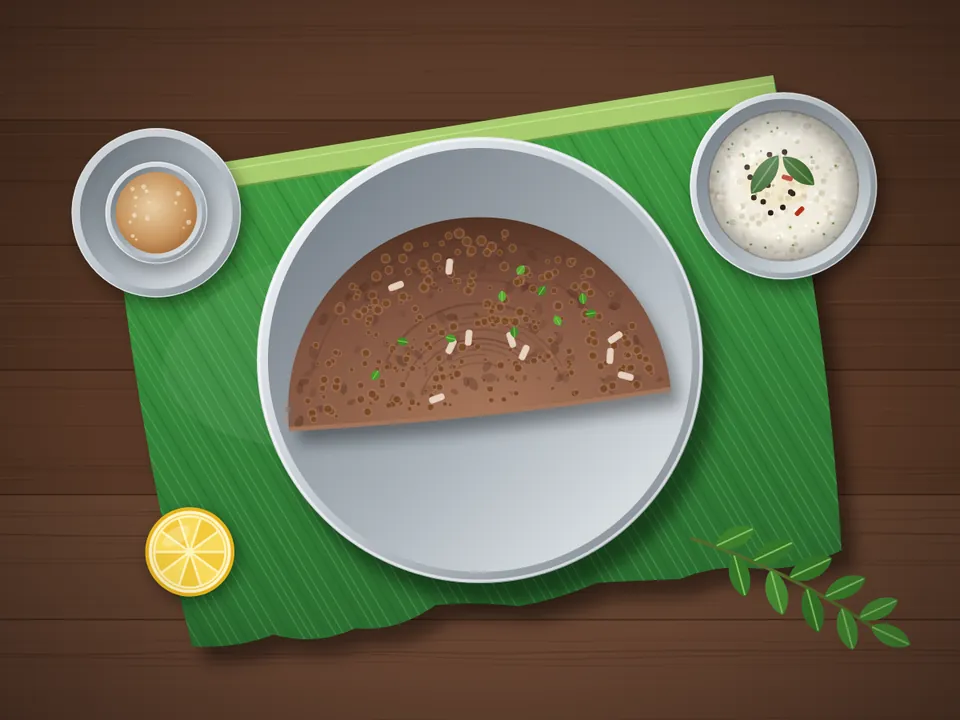
Ragi dosa is a crisp, lacy crepe made from finger millet flour, with a little rice flour and rava for crunch. There is no soaking, grinding or fermenting, so you can mix the batter, rest it briefly and have hot dosas on the table in well under an hour. It is filling, earthy and naturally rich in calcium and fiber.
- Prep10 min
- Cook20 min
- Waiting15 min
- Servings4
- Total45 min · Per serving≈270 kcal
Ingredients
Tap an ingredient to tick it off as you cook.
Method
Waiting: Resting the batter (15 min)
- Mix the flours. Combine the ragi flour, rice flour, rava and salt in a bowl, add the yogurt and 2 cups water and whisk until there are no lumps.
- Add the flavorings. Stir in the onion, green chillies, ginger, cumin, curry leaves and coriander.
- Rest the batter. Leave it for 15 minutes so the rava softens, then add more water if needed; the batter should be thin, like buttermilk.
- Heat the pan. Heat a cast-iron or non-stick tawa on medium-high heat and wipe it with a little oil.
- Pour the dosa. Stir the batter well, then pour a ladleful from a height in a circle, starting at the edge and working inward, and fill only the large gaps; do not spread it with the ladle.
- Cook until crisp. Drizzle ½ tsp oil around the edges and cook for 2–3 minutes on medium heat until the edges lift and the base is crisp; there is no need to flip.
- Fold and repeat. Fold the dosa and serve, stirring the batter before each dosa because the flour settles at the bottom.
About this dish
Ragi, or finger millet, is a staple grain in Karnataka, where it is eaten daily as ragi mudde, and it is widely grown across the dry regions of South India. In Kannada this dish is ragi dose, in Tamil kezhvaragu dosai or kelvaragu dosai, and in Telugu ragi attu. It is a common home breakfast, especially in families who want a lighter, millet-based meal.
This instant version uses a thin, pourable batter, much like rava dosa, which gives a lacy, crisp result full of tiny holes. There is also a fermented style where ragi flour is mixed into regular dosa batter. Ragi browns less than rice, so the dosa stays dark reddish-brown when cooked; judge doneness by crisp edges and a dosa that lifts easily from the pan.
Tips
- Always stir the batter before pouring each dosa, as the flours sink quickly.
- If the dosa breaks, the pan is not hot enough or the batter is too thick; add 2–3 tbsp water.
- For a softer dosa, use a little thicker batter and spread it like a regular dosa, then cook both sides.
Serve with
Serve hot with coconut chutney, peanut chutney or sambar.
Goes well with: Coconut Chutney, Peanut Chutney, Sambar